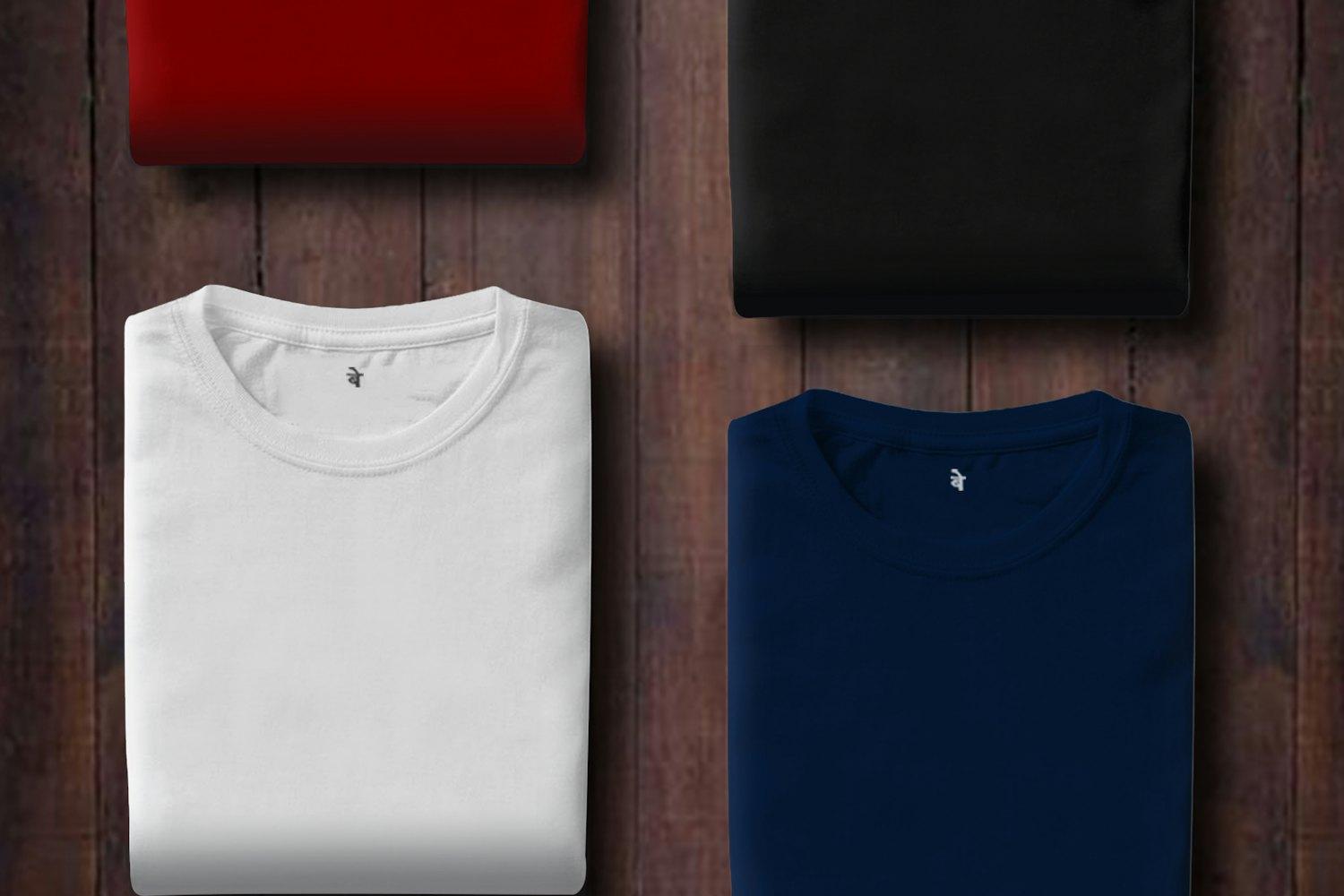
Basic / regular t-shirt
Soft, breathable and durable in everyday washing. 160–180 gsm is the most common range.
- Recommended:
- Single jersey, Interlock, Viscose / modal jersey
- Weight:
- 150–200 gsm
- Avoid:
- Rib knit, Fleece (3-thread)

Guide
The fabric decides how your garment looks, fits and feels, and a large part of its price. Use this guide to find the right fabric family and weight for your product, then see what each fabric does well and where it falls short.
Knits (jersey, rib, fleece) are made of loops: they stretch and feel soft, like a t-shirt. Wovens (poplin, twill, denim) are made of crossing threads: they hold their shape and don't stretch unless elastane is added, like a shirt or jeans.
Grams per square metre. A light summer t-shirt is around 140–160 gsm, a heavyweight streetwear tee 240–280 gsm, a winter hoodie 320–400 gsm. The same fabric family can look and feel very different at another weight.
Fitted styles need stretch and recovery; flowy styles need drape; structured styles need body. Decide which your design needs before choosing the fabric.
Recommended fabrics are listed best first. Weights are typical ranges; your design may need something different.
Soft, breathable and durable in everyday washing. 160–180 gsm is the most common range.
Body and structure, so the boxy cut holds its shape and doesn't show through. 240–280 gsm.
Stretch and recovery so it follows the body, and opaque enough for light colours.
A neat, breathable body fabric with a separate rib collar and cuffs.
A little heavier and warmer than a summer tee, still comfortable.
Thick and warm, usually brushed (fleecy) on the inside.
The sweatshirt look in a lighter, more breathable fabric for spring and summer.
Comfortable and durable, without bagging at the knees.
Four-way stretch, compression and recovery, and no see-through when squatting.
Wicks sweat, dries fast and stays light.
Smooth, crisp after ironing and breathable.
Relaxed and breathable, with a natural or printed look.
Heavier and structured, worn like a light jacket.
Sturdy and structured, sometimes with a little elastane for comfort.
A smooth fabric that holds a crease, with balanced drape.
Light and drapey, so the leg moves when walking.
Durable denim, rigid or stretch, suitable for the wash you want.
Depends on the style: woven shorts hold their shape, knit shorts are relaxed.
Stretch and recovery, opaque, smooth over the body.
Light, drapey and breathable.
Holds a collar and placket like a shirt, but falls softly as a dress.
Soft and comfortable, thick enough not to show through in light colours.
Sheen, drape or texture; usually lined, with careful finishing.
Structured and close to the body, without bagging when sitting.
Drapey; if pleated, a fabric that holds pleats (usually polyester).
Structured with a smooth surface; shaped with lining and interfacing.
Warm or wind-resistant, heavy and structured.
Protection from wind and rain; warmth from padding or lining.
Very soft, breathable, durable in frequent washing, ideally certified.
Very soft and comfortable, for summer or winter.
The fabric families we work with most, with typical weights and what each is best for.
Knit · 220–300 gsm · Slight stretch
Thick cotton single jersey with a firm, dense hand. The fabric behind most streetwear t-shirts.
Best for: Oversized and boxy t-shirts, heavy basics, long sleeves, t-shirt dresses.
Not ideal for: Fitted styles, light summer pieces, drapey dresses.
Knit · 160–250 gsm · Good stretch
Single jersey with elastane: follows the body, stretches and springs back.
Best for: Fitted t-shirts, crop tops, bodysuits, fitted jersey dresses.
Not ideal for: Oversized tees (elastane spoils the boxy drape), heavy sweatshirts.
Knit · 140–200 gsm · Good stretch
A very soft, cool and drapey knit.
Best for: Drapey tees and tops, jersey dresses, pyjamas, underwear.
Not ideal for: Structured styles, large heavy prints.
Knit · 120–180 gsm · Good stretch
A polyester knit that wicks sweat and dries fast.
Best for: Sports tees, running tops, team jerseys, training shorts.
Not ideal for: Everyday pieces where a cotton feel is wanted.
Knit · 130–200 gsm · Slight stretch
The classic t-shirt fabric: soft and breathable, smooth on the face and looped on the back.
Best for: Basic and regular t-shirts, kids' tees, bodysuits, pyjama tops, linings.
Not ideal for: Structured styles; fitted styles without elastane.
Knit · 180–320 gsm · Good stretch
A ribbed knit (1x1, 2x2) that stretches a lot across the width and springs back.
Best for: Collars, cuffs and hems; fitted tops, crop tops, bodycon dresses.
Not ideal for: Structured or wide styles; large prints (the ribs break them up).
Knit · 180–260 gsm · Slight stretch
A double knit, smooth on both sides: thicker than single jersey, doesn't curl and feels substantial.
Best for: Kids' and baby wear, premium tees, t-shirt dresses, pyjamas.
Not ideal for: Very light summer pieces, heavy winter pieces.
Knit · 260–380 gsm · Good stretch
A thick, firm double knit: it stretches but holds its shape like a woven.
Best for: Pencil skirts, fitted dresses, women's trousers, knit blazers.
Not ideal for: Summer pieces that need to breathe; t-shirts.
Knit · 180–240 gsm · Slight stretch
A knit with a honeycomb texture: breathable and neat.
Best for: Polo shirts, summer sports tops, uniforms.
Not ideal for: Drapey styles, large prints.
Knit · 280–450 gsm · Slight stretch
Thick sweatshirt fabric, usually brushed and fluffy on the inside, warm. Also made unbrushed.
Best for: Winter hoodies and sweatshirts, sweatpants, oversized sweats.
Not ideal for: Summer pieces, light and drapey styles.
Knit · 220–320 gsm · Slight stretch
Smooth on the face with loops on the back (unbrushed): the lighter sweatshirt fabric.
Best for: Spring and summer sweatshirts and hoodies, joggers, shorts, kids' sets.
Not ideal for: Winter pieces (not warm enough), fitted styles.
Knit · 180–300 gsm · Slight stretch
A knit with a square, waffle-like texture: relaxed and textured.
Best for: Thermal long sleeves, loungewear, relaxed sets.
Not ideal for: Print-led pieces, formal wear.
Knit · 250–380 gsm · High stretch (4-way)
A thick, smooth knit with elastane that holds its shape.
Best for: Bodycon and structured dresses, pencil skirts, sculpted shapes.
Not ideal for: Summer pieces that need to breathe; a cotton feel.
Knit · 180–350 gsm · Slight stretch
A light, warm polyester knit, fluffy on both sides.
Best for: Fleece jackets and vests, mid-layers, kids' winter pieces, linings.
Not ideal for: Pieces where a cotton feel is wanted, printed fashion pieces.
Knit · 200–350 gsm · Slight stretch
A long-pile, very soft and warm polyester knit.
Best for: Winter pyjamas, robes, kids' onesies; hood and jacket linings.
Not ideal for: Summer pieces, fitted styles.
Knit · 250–350 gsm · Slight stretch
A knit with a short, soft pile and a slight sheen.
Best for: Tracksuits, loungewear, kids' sets.
Not ideal for: Summer pieces.
Knit · 180–300 gsm · High stretch (4-way)
A high-elastane, compressive fabric with four-way stretch.
Best for: Leggings, sports bras, bike shorts, yoga and gym tops; chlorine-resistant qualities for swimwear.
Not ideal for: Loose everyday pieces.
Knit · 80–180 gsm · Slight stretch
An open, perforated knit for ventilation and linings.
Best for: Ventilation panels and linings in sportswear, team jerseys.
Not ideal for: Pieces worn on their own without lining.
Knit · 200–350 gsm · Slight stretch
A knit with the pattern knitted in.
Best for: Patterned dresses, skirts, knit jackets, sweatshirts.
Not ideal for: Simple, plain, price-led pieces.
Knit · Chosen by yarn and gauge, not weight · Good stretch
Not bought as fabric: each piece is knitted to shape on a flat knitting machine. Yarn and gauge are chosen instead of weight.
Best for: Sweaters, cardigans, knit dresses, knit polos, beanies.
Not ideal for: Garments meant to be cut and sewn from fabric.
Woven · 90–140 gsm · No stretch
A fine, tight plain weave: smooth, slightly lustrous and crisp after ironing.
Best for: Classic shirts, shirt dresses, blouses, kids' shirts, linings.
Not ideal for: Fitted styles that need stretch (without elastane), heavy outerwear.
Woven · 120–180 gsm · No stretch
A basket weave shirting, heavier and more textured than poplin.
Best for: Casual shirts, button-down shirts.
Not ideal for: Drapey blouses, evening wear.
Woven · 270–480 gsm · No stretch
A twill with indigo-dyed warp, rigid or stretch. Weight is usually given in ounces: 8–14 oz is about 270–480 gsm.
Best for: Jeans, shorts, jackets, skirts, overalls; light denim and chambray for shirts.
Not ideal for: Drapey, light styles (except light denim).
Woven · 250–400 gsm · No stretch
A cotton weave with raised vertical ribs (wales).
Best for: Trousers, overshirts, jackets, skirts, kids' trousers.
Not ideal for: Summer pieces.
Woven · 200–320 gsm · No stretch
A sturdy, structured weave with a diagonal line.
Best for: Chinos and cargo trousers, shorts, overshirts, trench coats, workwear, skirts.
Not ideal for: Drapey dresses, flowy summer pieces.
Woven · 280–450 gsm · No stretch
A thick, tight plain weave, very durable.
Best for: Workwear jackets, bags, aprons, heavy trousers.
Not ideal for: Soft everyday pieces, dresses.
Woven · 140–220 gsm · No stretch
Linen with viscose or cotton: the linen look at a lower price, with fewer creases and a softer drape.
Best for: Summer dresses, wide trousers, shirts, co-ord sets.
Not ideal for: Structured jackets.
Woven · 140–250 gsm · No stretch
Made from flax: cool to wear, naturally textured, and it creases a lot.
Best for: Summer shirts, trousers, dresses, suits, shorts.
Not ideal for: Pieces that must not crease, fitted styles.
Woven · 100–150 gsm · No stretch
A light, soft and very drapey weave, often used for printed fabrics.
Best for: Summer dresses, blouses, wide trousers, skirts, pyjamas.
Not ideal for: Structured styles.
Woven · 120–220 gsm · Slight stretch
A drapey weave with a slightly grainy surface that creases little.
Best for: Blouses, dresses, trousers, skirts, jumpsuits, evening wear.
Not ideal for: Sportswear and casual cotton pieces.
Woven · 40–90 gsm · No stretch
A very fine, sheer and floaty weave.
Best for: Flowy dresses and blouses (lined), overlays on evening wear, scarves.
Not ideal for: Unlined everyday pieces, fitted styles.
Woven · 80–160 gsm · No stretch
A weave with a glossy, smooth face.
Best for: Slip dresses, evening wear, blouses, pyjamas, skirts, linings.
Not ideal for: Everyday pieces that need to be hard-wearing.
Woven · 200–350 gsm · No stretch
A weave with a short, dense pile and deep colour.
Best for: Evening wear, blazers, skirts, winter dresses.
Not ideal for: Summer pieces and items washed often.
Woven · 90–150 gsm · No stretch
A loosely woven, usually double-layer cotton with a soft, crinkled look.
Best for: Baby and kids' wear, summer shirts, beach dresses, pyjamas.
Not ideal for: Structured styles.
Woven · 200–300 gsm · Good stretch
A stretch weave with fine ribs that stretches across the width.
Best for: Women's trousers (slim and flared), pull-on trousers, skirts.
Not ideal for: Men's tailored trousers, shirts.
Woven · 200–320 gsm · Slight stretch
A firm, smooth weave for suits and tailored trousers.
Best for: Blazers, suits, tailored trousers, waistcoats, skirts.
Not ideal for: Casual sportswear.
Woven · 400–700 gsm · No stretch
A thick coating fabric with a felted surface.
Best for: Coats, overcoats, heavy jackets, winter skirts.
Not ideal for: Inner layers, summer pieces.
Woven · 80–320 gsm · Slight stretch
Coated or membrane fabrics (taslan, softshell, water-repellent) that protect from wind and rain.
Best for: Jackets, parkas, raincoats, windbreakers, softshell jackets.
Not ideal for: Everyday inner pieces where a cotton feel is wanted.
Other · 60–200 gsm · Slight stretch
An open, patterned decorative fabric.
Best for: Evening dresses, lingerie, blouse details, evening-wear details.
Not ideal for: Unlined everyday pieces.
Other · 20–60 gsm · Slight stretch
A very light, sheer net fabric.
Best for: Full skirts, evening-wear overlays, girls' party dresses.
Not ideal for: Single-layer everyday pieces.
Other · 250–500 gsm · Slight stretch
A polyurethane coating on a knit or woven base.
Best for: Jackets, skirts, trousers, trims and details.
Not ideal for: Pieces that need to breathe.
Grams per square metre: the weight of the fabric. Higher gsm usually means a thicker, more substantial fabric. For a t-shirt, 140–160 gsm feels light, 180–200 gsm is a solid everyday weight and 240 gsm and up is heavyweight.
Knits are made of interlocking loops, so they stretch and feel soft (t-shirts, hoodies, leggings). Wovens are made of threads crossing at right angles, so they hold their shape and only stretch if elastane is added (shirts, jeans, trousers).
100% cotton feels natural and breathes well. A little elastane adds stretch and recovery; polyester in a blend reduces shrinking and creasing and lowers the price. The right choice depends on the garment and how it will be worn and washed.
Yes. Send us the garment or clear photos with its care label. The label tells us the composition, and we can check the weight and construction from the garment itself, then suggest the closest fabrics.
Yes, that is no problem at all. Tell us the fabric and quantity and we'll plan the cutting and production around it.
Narrow it down with this guide, then decide on a physical swatch or a sample. Feel, drape and colour are hard to judge on screen, so the final choice is always best made in hand.
Send us your design, a photo or a reference garment and we'll suggest fabric options for it.